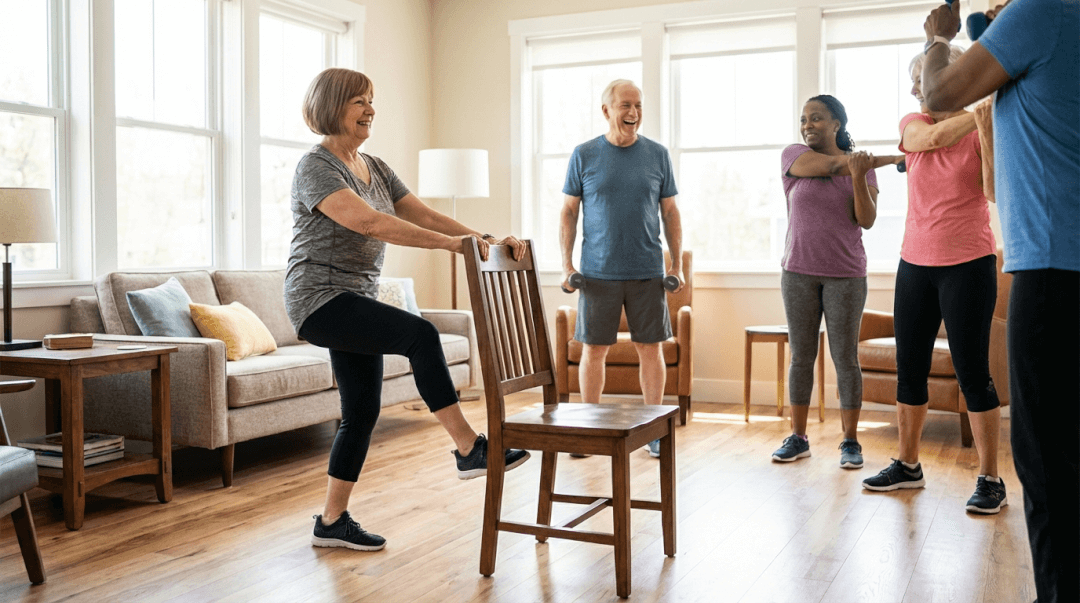

You do not need a gym membership, expensive equipment, or a personal trainer to stay strong, balanced, and independent. You need a sturdy chair, a clear patch of floor, and about 15 to 20 minutes a day.
If you have been putting off exercise because you are worried about injury, or because you think it is “too late” to build muscle, here is the short answer: it is not too late. Research consistently shows that adults over 60, 70, and even 80 can build strength, improve balance, and reduce fall risk with the right routine. The key is to start safely, stay consistent, and choose exercises that match your current ability.
We have compiled 18 safe, effective exercises you can do at home, organized into four categories: balance, strength, flexibility, and cardio. Each one includes step-by-step instructions, safety tips, and modifications for different fitness levels. At the end, you will find a sample weekly routine to tie it all together.
In This Article
Safety First: How to Start Without Injury
Before you try a single exercise on this list, review these four ground rules. They are simple, but skipping them is how injuries happen.
1. Talk to Your Doctor
If you have a chronic condition (heart disease, diabetes, severe arthritis, osteoporosis), consult your doctor or physical therapist before starting. They can flag specific movements to avoid and recommend modifications for your situation.
2. Set Up Your Space
Your exercise area matters more than you think. Follow this checklist:
- Remove loose rugs and cords from the floor (trip hazards).
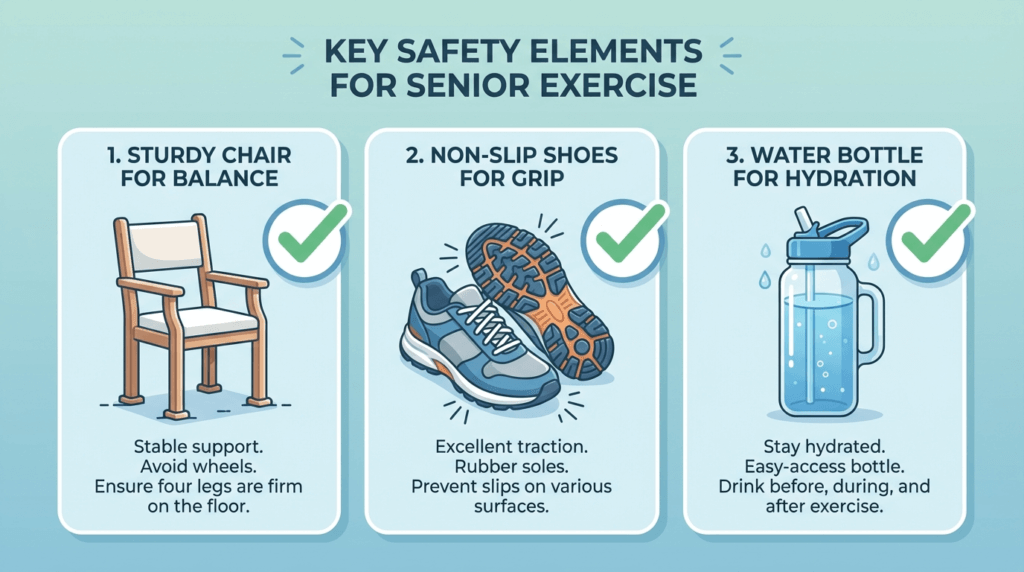
- Use a sturdy, high-backed chair without wheels for any exercise that requires support. A dining chair on a non-slip surface is ideal.
- Wear non-slip shoes with good grip, not socks or bare feet. (Need recommendations? See our guide to Velcro Shoes for the Elderly)
3. Stay Hydrated
Keep a water bottle within arm’s reach. Dehydration causes dizziness, and dizziness causes falls. Drink water before, during, and after your routine.
4. Listen to Your Body
“No pain, no gain” does not apply here. Mild muscle fatigue is normal. Sharp pain, dizziness, chest tightness, or shortness of breath is not. Stop immediately if you experience any of those symptoms and consult your doctor.
Part 1: Balance and Fall Prevention
Falls are the leading cause of injury for adults over 65. The good news: balance is a skill, and like any skill, it improves with practice. These four exercises target the stabilizing muscles in your legs, core, and ankles.
How often: Aim for balance exercises at least 3 days per week.
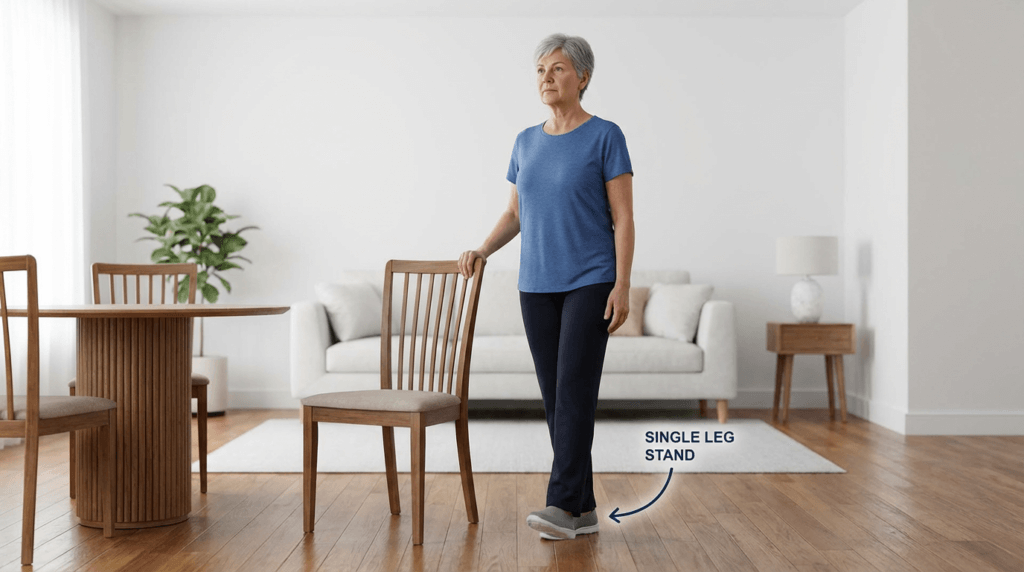
Exercise 1: Single Leg Stand
Why it works: This is the gold standard for balance training. It forces your stabilizing muscles to activate and strengthens ankle control.
How to do it:
- Stand next to a sturdy chair or counter. Place one hand lightly on the surface for support.
- Slowly lift one foot off the ground, bending the knee slightly.
- Hold for 10 to 30 seconds (or as long as you can maintain control).
- Lower your foot and switch sides.
- Repeat 3 times per leg.
Modifications:
- Beginner: Keep both hands on the chair and lift your foot only an inch off the floor.
- Advanced: Try it without holding the chair. Close your eyes for an extra challenge (only if you feel stable and have someone nearby).
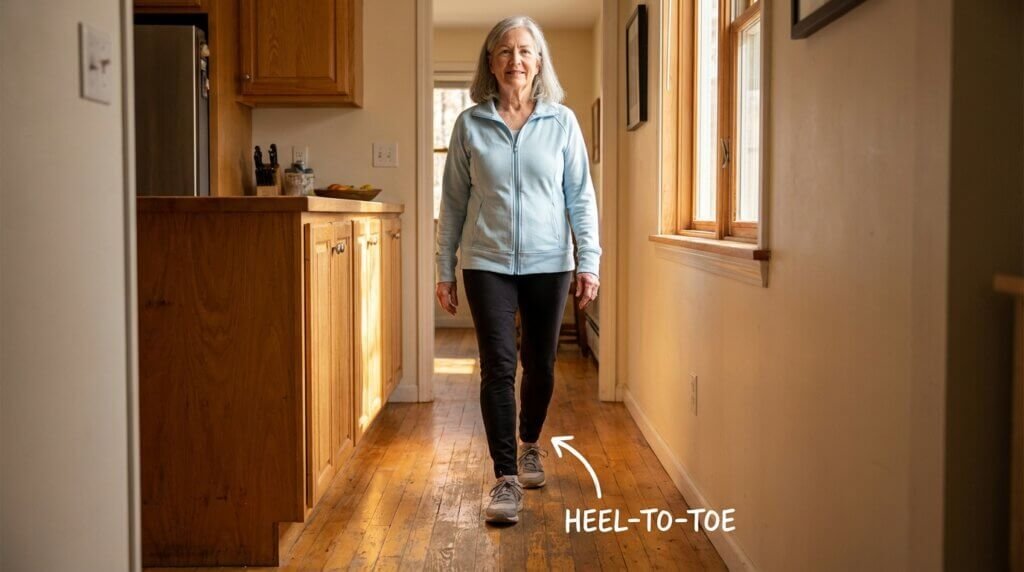
Exercise 2: Heel-to-Toe Walk (Tandem Walk)
Why it works: This movement mimics the kind of precise foot placement you need to walk confidently on uneven surfaces.
How to do it:
- Stand at one end of a hallway or along a kitchen counter (for something to grab if needed).
- Place the heel of your right foot directly in front of the toes of your left foot.
- Step forward with your left foot, placing its heel in front of your right toes.
- Walk 15 to 20 steps in a straight line.
- Turn around carefully and repeat.
Tip: Focus your gaze on a fixed point ahead, not at your feet. This trains your vestibular system (your inner ear’s balance mechanism).
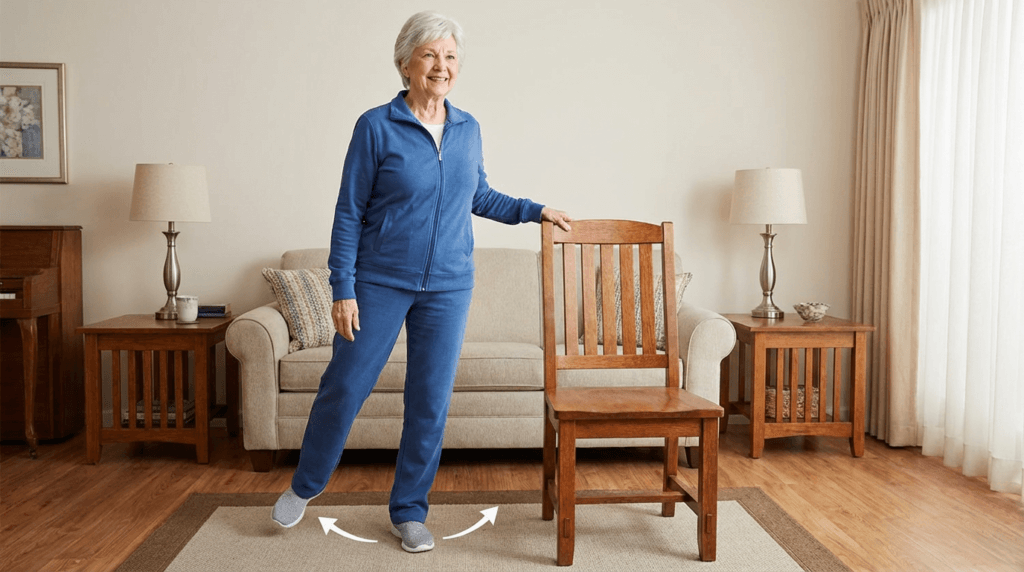
Exercise 3: Rock the Boat
Why it works: Trains your body to recover from sideways shifts, which is the direction most real-world falls happen.
How to do it:
- Stand with feet hip-width apart. Hold a chair or counter for support if needed.
- Slowly shift your weight onto your right foot.
- Lift your left foot off the ground and hold for 5 to 10 seconds.
- Lower your left foot and shift your weight to the left side.
- Lift your right foot and hold for 5 to 10 seconds.
- Repeat 5 times per side.
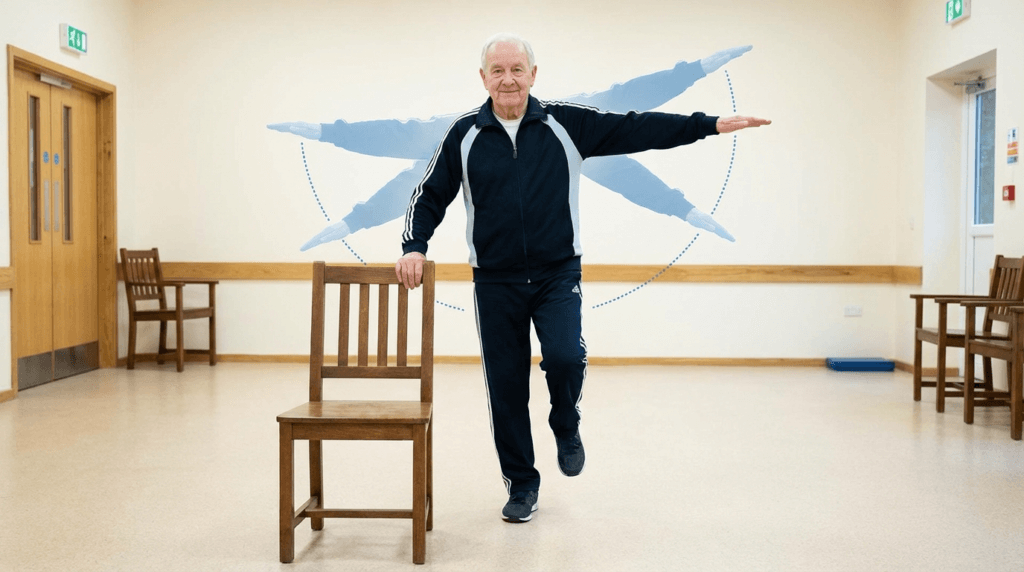
Exercise 4: Clock Reach
Why it works: Combines single-leg balance with reaching, which trains your body to stay stable while your center of gravity shifts (like when you reach for something on a shelf).
How to do it:
- Stand next to a chair with your left hand on the chair for support.
- Lift your right leg slightly off the ground.
- With your right arm, point straight ahead (12 o’clock), then out to the side (3 o’clock), then behind you (6 o’clock).
- Return to standing. Switch sides.
- Repeat 3 times per side.
Part 2: Strength Training (Upper and Lower Body)
After age 30, adults lose approximately 3% to 5% of muscle mass per decade. This process, called sarcopenia, accelerates after 60. The result: everyday tasks like getting out of a chair, carrying groceries, or climbing stairs become harder.
Strength training reverses this. Even modest resistance exercise 2 to 3 times per week can measurably increase muscle mass and functional ability in seniors.
Lower Body
Your legs and hips are the foundation. These four exercises target the muscles you use to stand up, walk, and climb stairs.
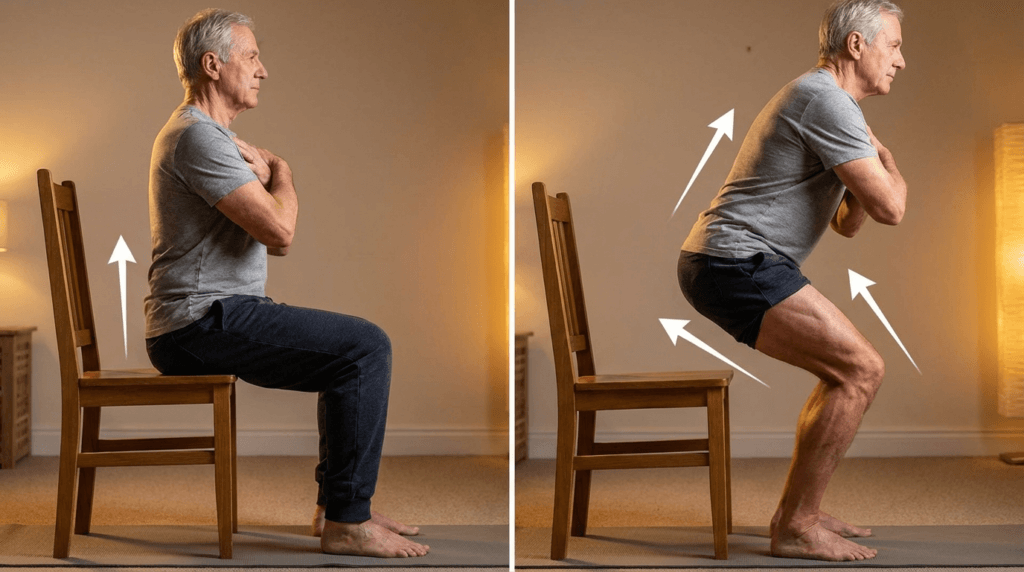
Exercise 5: Chair Squats (Sit-to-Stand)
Why it works: This is the single most functional exercise on this list. Every time you get out of a chair, a car seat, or a toilet, you are doing a version of this movement. Training it builds the leg and core strength that keeps you independent.
How to do it:
- Sit toward the front edge of a sturdy chair. Feet flat on the floor, hip-width apart.
- Cross your arms over your chest (or extend them forward for balance).
- Lean slightly forward from your hips and push through your heels to stand up.
- Pause at the top. Stand tall.
- Slowly lower yourself back into the chair with control. Do not drop into the seat.
- Repeat 8 to 12 times.
Modifications:
- Beginner: Use your hands on the chair arms or your thighs to assist. Work toward doing it hands-free.
- Advanced: Hold a light weight (5 to 10 lbs) at your chest while performing the movement.
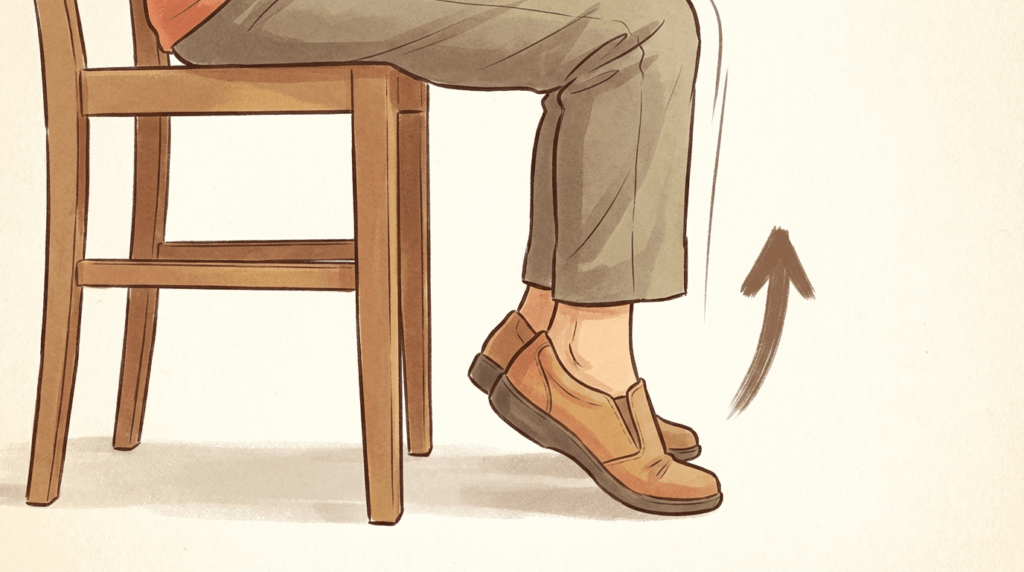
Exercise 6: Calf Raises
Why it works: Your calf muscles power the push-off phase of walking. Weak calves lead to shuffling and instability.
How to do it:
- Stand behind a chair with both hands resting lightly on the back for balance.
- Slowly rise up onto your toes, lifting your heels as high as comfortable.
- Hold for 2 to 3 seconds at the top.
- Lower your heels back to the floor slowly.
- Repeat 10 to 15 times.
Tip: Focus on the lowering phase. Controlling the descent builds more strength than the lift itself.
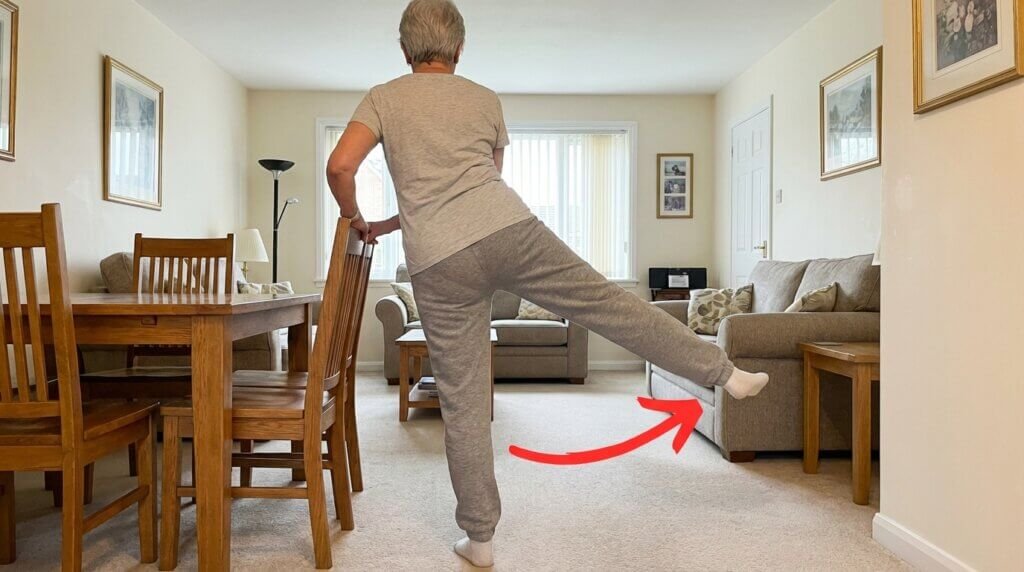
Exercise 7: Side Leg Raises
Why it works: Strengthens the hip abductors (outer hip/glute muscles), which are critical for lateral stability and preventing sideways falls.
How to do it:
- Stand behind a chair, holding the back for support.
- Keep your body straight and slowly lift one leg out to the side, about 6 to 12 inches.
- Hold for 2 seconds.
- Lower the leg slowly. Do not swing it.
- Repeat 10 to 15 times per leg.
Key form point: Keep your toes pointing forward, not outward. If your toes rotate out, you are using your hip flexors instead of your glutes.
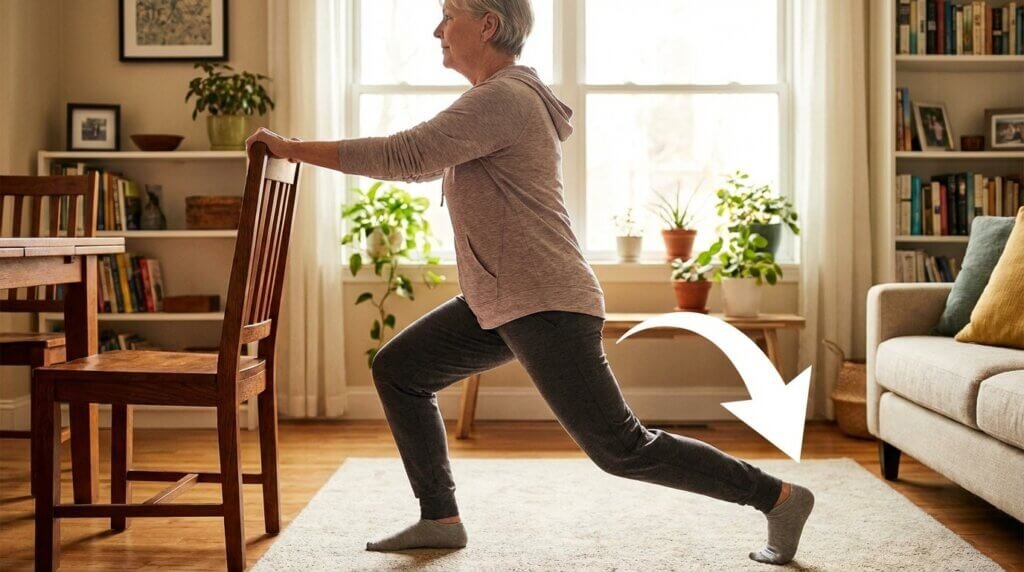
Exercise 8: Step-Back Lunges
Why it works: Builds quad and glute strength in a single-leg pattern that mimics stepping over obstacles or climbing stairs.
How to do it:
- Stand facing a chair or counter, holding it for support.
- Step your right foot back about 12 to 18 inches.
- Bend both knees slightly, lowering your body a few inches. Your front knee should stay over your ankle, not past your toes.
- Push through your front heel to return to standing.
- Repeat 8 to 10 times per leg.
Modifications:
- Beginner: Make the step-back very small and bend your knees only slightly.
- Advanced: Hold light dumbbells at your sides.
Upper Body
Strong arms and shoulders make everyday tasks like lifting groceries, opening jars, and reaching overhead easier and safer.
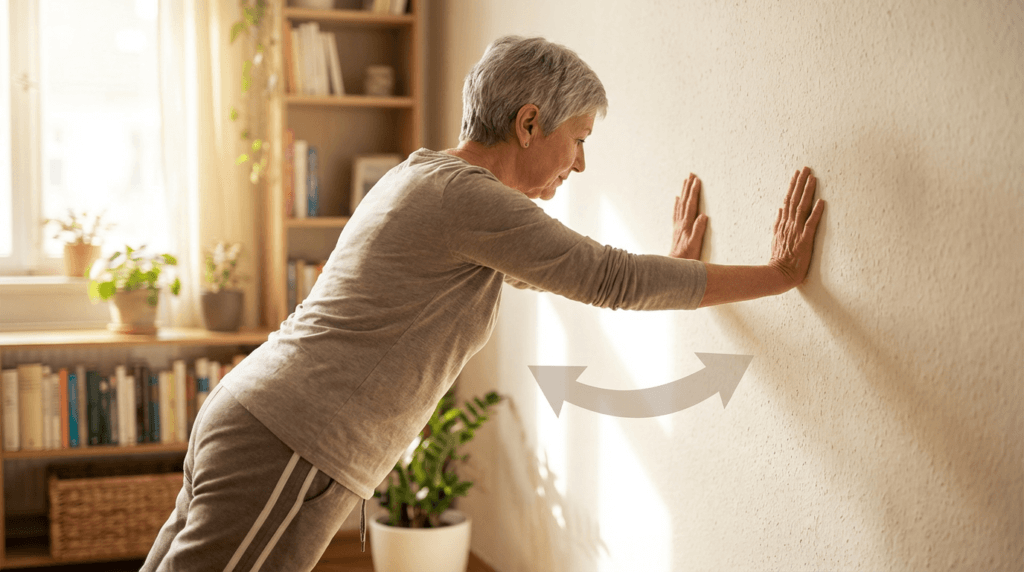
Exercise 9: Wall Push-Ups
Why it works: Builds chest, shoulder, and tricep strength without getting on the floor. This is one of the safest upper-body exercises for seniors.
How to do it:
- Stand facing a wall, about arm’s length away.
- Place your palms flat on the wall at shoulder height and shoulder width apart.
- Bend your elbows and slowly bring your chest toward the wall.
- Push back to the starting position.
- Repeat 10 to 15 times.
Modifications:
- Easier: Stand closer to the wall (less resistance).
- Harder: Stand farther from the wall, or use a sturdy kitchen counter instead.
Exercise 10: Seated Bicep Curls
Why it works: Strengthens the muscles you use to lift and carry things.
How to do it:
- Sit in a sturdy chair with your feet flat on the floor.
- Hold a light weight in each hand (start with 2 to 5 lbs, or use water bottles/soup cans).
- Start with arms at your sides, palms facing forward.
- Slowly curl the weights toward your shoulders, keeping your elbows close to your body.
- Pause at the top, then slowly lower back down.
- Repeat 10 to 12 times.
Tip: If you do not own dumbbells, a 16 oz water bottle weighs about 1 lb and a large can of soup weighs about 1.5 lbs. They work perfectly.

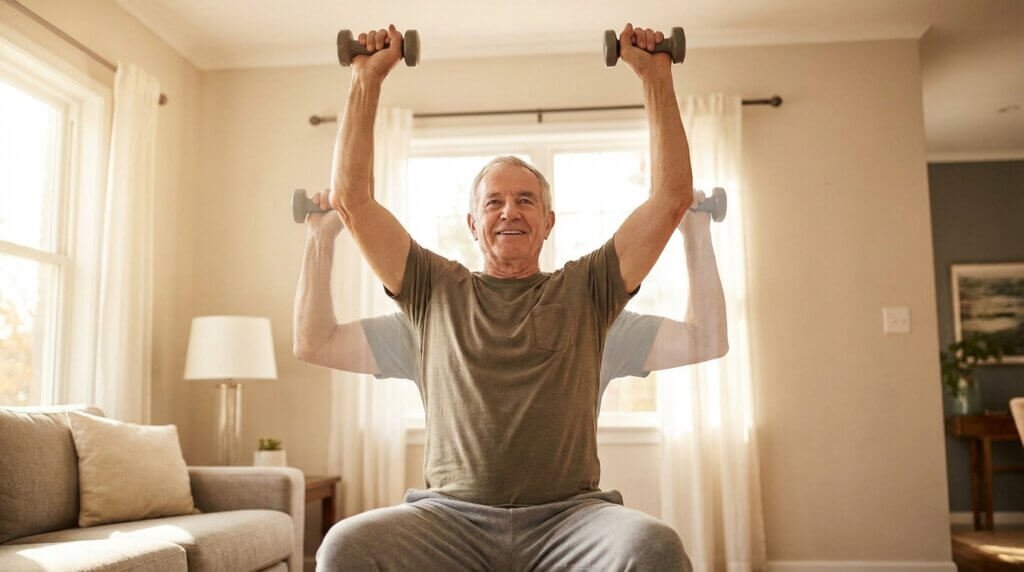
Exercise 11: Overhead Press
Why it works: Strengthens the shoulders and upper back. Strong shoulders make reaching overhead (kitchen cabinets, closet shelves) safer.
How to do it:
- Sit or stand with a light weight in each hand (2 to 5 lbs).
- Start with the weights at shoulder height, palms facing forward.
- Press the weights straight up overhead until your arms are nearly straight (do not lock your elbows).
- Slowly lower back to shoulder height.
- Repeat 8 to 10 times.
Caution: If you have shoulder pain or limited range of motion, do not force the overhead position. Press only as high as is comfortable and pain-free.
Part 3: Flexibility and Mobility
Stiff joints lead to compensation. Compensation leads to poor posture. Poor posture leads to pain. Breaking that cycle starts with gentle mobility work for 5 to 10 minutes a day.
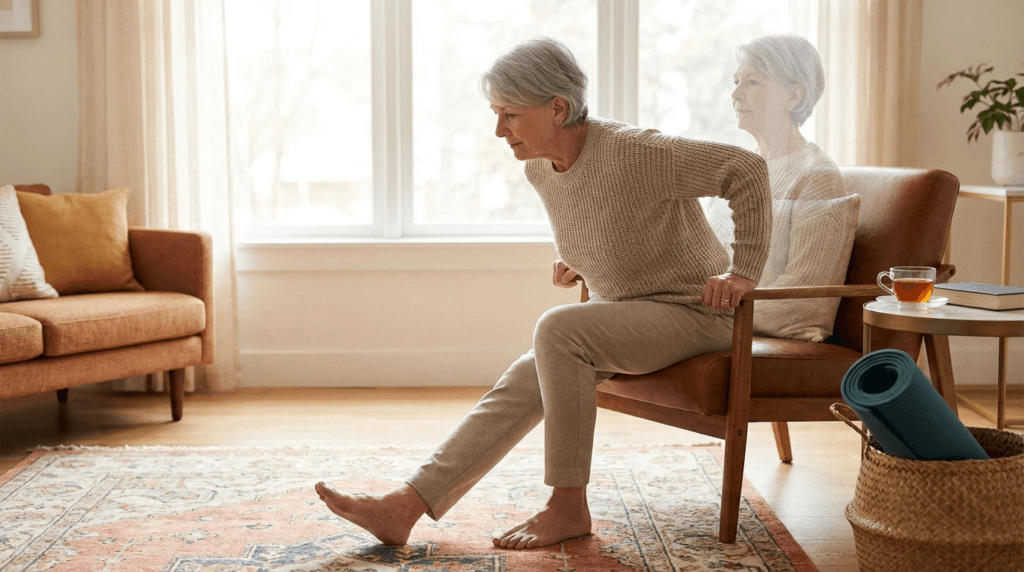
Exercise 12: Seated Hamstring Stretch
Why it works: Tight hamstrings contribute to lower back pain and make walking feel effortful. This stretch targets the back of the thigh safely.
How to do it:
- Sit on the edge of a sturdy chair.
- Extend one leg straight out in front of you, resting your heel on the floor with your toes pointing up.
- Keep your back straight (do not hunch) and gently lean forward from your hips.
- You should feel a mild stretch along the back of your extended leg.
- Hold for 20 to 30 seconds.
- Switch legs. Repeat 2 to 3 times per side.
Exercise 13: Shoulder Rolls
Why it works: Relieves tension in the neck and upper back, which often builds up from sitting or poor posture.
How to do it:
- Sit or stand with arms relaxed at your sides.
- Slowly roll your shoulders forward in a circular motion: up, forward, down, back.
- Repeat 10 times forward.
- Reverse direction and roll backward 10 times.
Tip: Make the circles slow and deliberate. You should feel the muscles around your shoulder blades engaging on the backward roll.

Exercise 14: Neck Rotations
Why it works: Maintains the range of motion needed for turning your head (essential for driving, crossing streets, and general awareness of your surroundings).
How to do it:
- Sit tall in a chair with your shoulders relaxed.
- Slowly turn your head to the right, bringing your chin toward your shoulder.
- Hold for 5 seconds.
- Return to center, then turn to the left.
- Hold for 5 seconds.
- Repeat 5 times each direction.
Caution: Never roll your head in full circles. This can compress the vertebrae in your neck. Stick to controlled side-to-side and chin-to-chest movements.

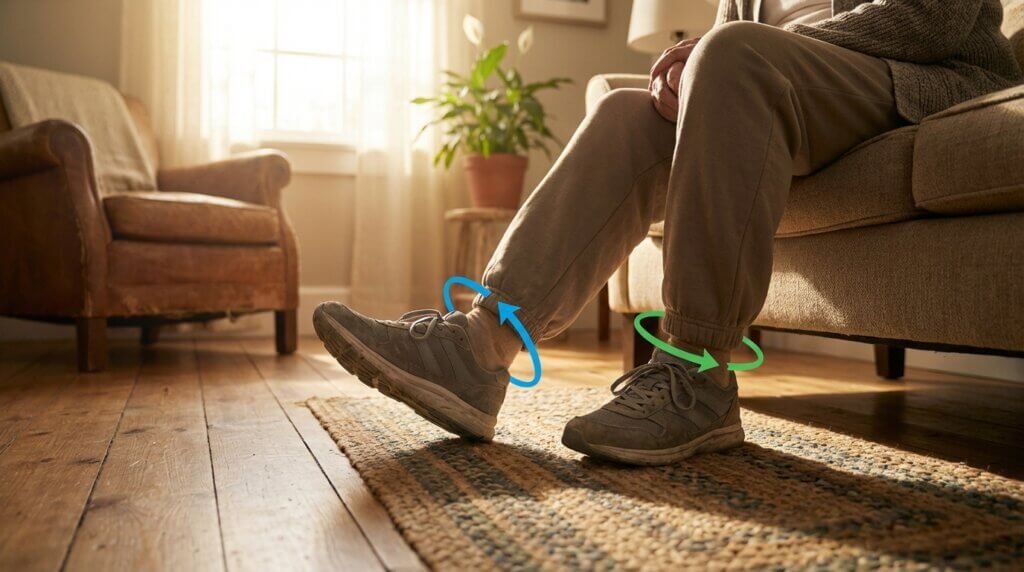
Exercise 15: Ankle Circles
Why it works: Ankle mobility directly affects your walking gait. Stiff ankles lead to shuffling, which increases fall risk.
How to do it:
- Sit in a chair and lift one foot slightly off the floor.
- Slowly rotate your ankle clockwise 10 times.
- Reverse direction and rotate counterclockwise 10 times.
- Switch feet.
Part 4: Low-Impact Cardio
The CDC recommends at least 150 minutes of moderate-intensity aerobic activity per week for adults over 65. That breaks down to about 20 to 25 minutes a day, 5 days a week, or 30 minutes a day, 5 days a week with rest days. You do not need to do it all at once; even three 10-minute sessions count.
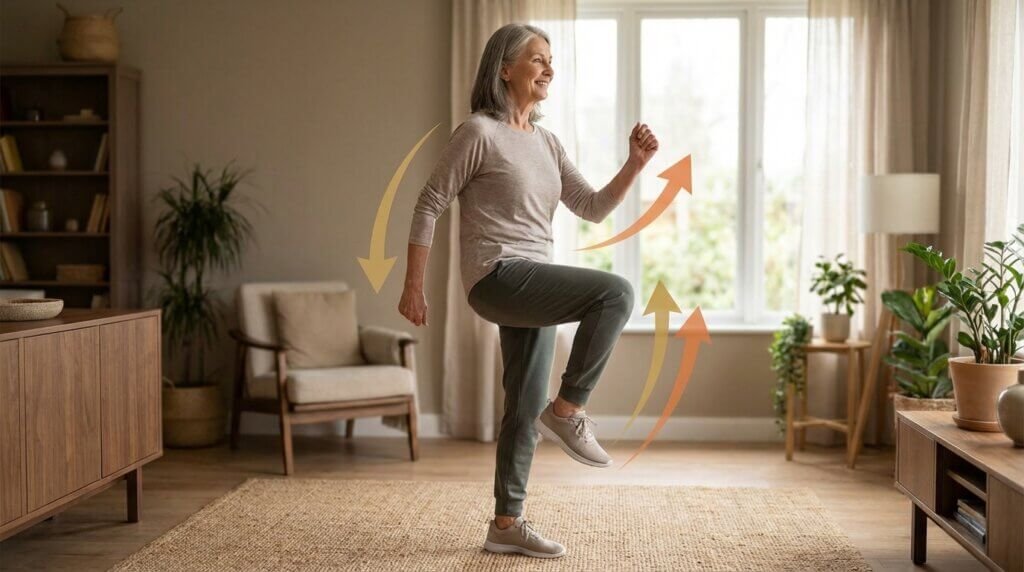
Exercise 16: Marching in Place
Why it works: Raises your heart rate, strengthens hip flexors, and improves coordination without the impact of walking outdoors on uneven ground.
How to do it:
- Stand near a chair or counter for support if needed.
- Lift your right knee toward your chest (as high as is comfortable), then lower it.
- Lift your left knee.
- Alternate at a steady rhythm for 1 to 3 minutes.
- Rest for 30 seconds. Repeat 3 to 5 sets.
Tip: Swing your arms naturally with each step to engage your upper body and increase your heart rate.
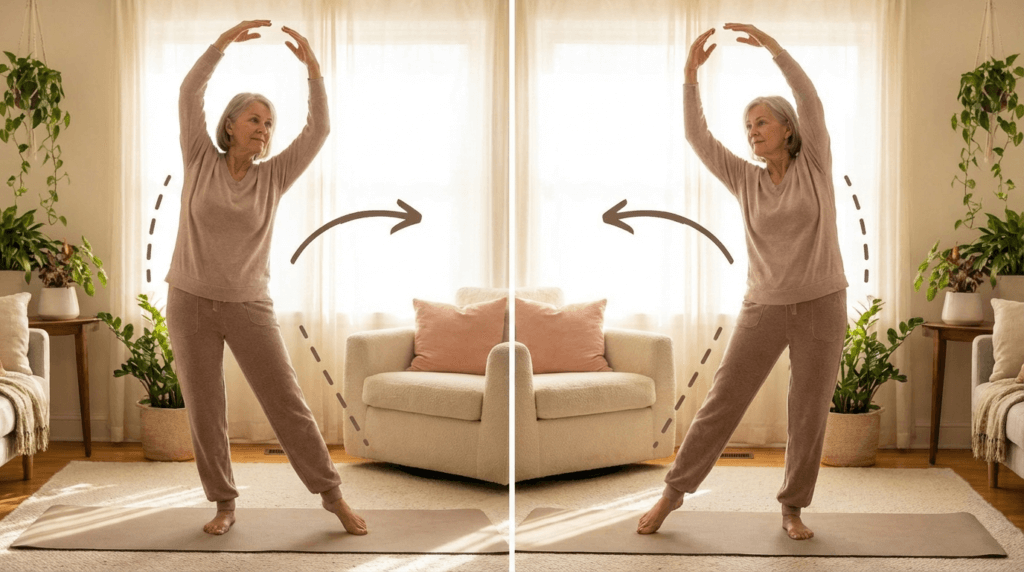
Exercise 17: Side Step Jacks
Why it works: Provides the cardiovascular benefit of jumping jacks without the impact on your joints.
How to do it:
- 1. Stand with feet together, arms at your sides.
- 2. Step your right foot out to the side while raising both arms overhead.
- 3. Step your right foot back to center and lower your arms.
- 4. Repeat on the left side.
- 5. Alternate for 1 to 2 minutes.
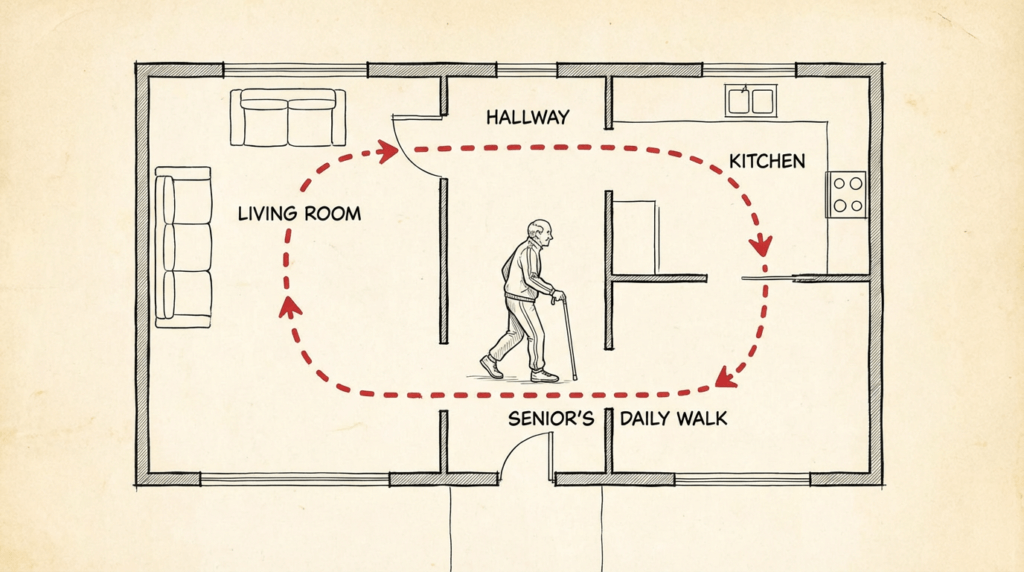
Exercise 18: Indoor Walking
Why it works: Walking is the most accessible form of cardio. Setting up an indoor route removes weather, terrain, and safety barriers.
How to set it up:
- Create a loop through your house (living room to kitchen to hallway and back).
- Remove trip hazards along the route.
- Walk at a brisk but comfortable pace for 10 to 20 minutes.
- Use a step tracker or a timer to monitor your progress.
Target: Work toward 8,000 to 10,000 steps per day. If you are starting from a sedentary baseline, begin with 2,000 to 3,000 steps and add 500 steps per week.
Equipment You Might Find Helpful (But Don’t Need)
You can do every exercise on this list with zero equipment. That said, a few inexpensive tools can add variety and progression as you get stronger.
| Equipment | Approximate Cost | Best For |
| Sturdy dining chair | You already have one | Balance support, seated exercises |
| Resistance bands (light) | $8 to $15 | Arm/leg strengthening, low joint stress |
| Light dumbbells (2-5 lbs) | $10 to $20 per pair | Bicep curls, overhead press |
| Water bottles / soup cans | Free | Beginner weight substitute |
| Non-slip yoga mat | $15 to $30 | Floor exercises, standing stability |
| Non-slip shoes | $25 to $60 | Safe footing during all exercises |
Sample Weekly Routine
This is a starting point. Adjust it to your fitness level and schedule. The goal is consistency, not intensity.
| Day | Focus | Duration | Example Exercises |
| Monday | Strength (Lower Body) + Balance | 20 min | Chair Squats, Calf Raises, Side Leg Raises, Single Leg Stand |
| Tuesday | Cardio + Flexibility | 20 min | Marching in Place, Indoor Walking, Hamstring Stretch, Shoulder Rolls |
| Wednesday | Rest or Light Stretch | 10 min | Ankle Circles, Neck Rotations, Shoulder Rolls |
| Thursday | Strength (Upper Body) + Balance | 20 min | Wall Push-Ups, Bicep Curls, Overhead Press, Heel-to-Toe Walk |
| Friday | Cardio + Flexibility | 20 min | Side Step Jacks, Indoor Walking, Seated Stretches |
| Saturday | Active Hobby | Varies | Gardening, dancing, walking with a friend |
| Sunday | Rest | — | Full rest day |
Frequently Asked Questions
How often should seniors exercise?
The CDC recommends at least 150 minutes of moderate-intensity aerobic activity per week, plus muscle-strengthening activities on 2 or more days per week. That does not mean you need 150 minutes of vigorous exercise. A 20-minute walk counts. Gardening counts. The exercises in this guide count.
What if I can’t stand for long periods?
Start with seated exercises. Chair Squats, Seated Bicep Curls, Shoulder Rolls, Ankle Circles, and the Seated Hamstring Stretch can all be done from a chair. As your strength and stamina improve, gradually add standing exercises with chair support.
Is it safe to exercise with arthritis?
In most cases, yes. Low-impact movement actually helps lubricate joints and reduce stiffness. Avoid high-impact activities (jumping, running) and any exercise that causes sharp joint pain. The flexibility exercises in this guide (shoulder rolls, ankle circles, hamstring stretch) are especially helpful for maintaining range of motion. Always check with your doctor if you have severe or inflammatory arthritis.
What’s the best time of day to exercise?
Whatever time you will actually do it consistently. Some people prefer mornings because they feel more energetic. Others prefer afternoons when joints are less stiff. The “best” time is the one that becomes a habit.
—
You do not need to train like an athlete. You need to build enough strength to get out of a chair, enough balance to walk with confidence, enough flexibility to turn your head while driving, and enough stamina to enjoy your day without exhaustion.
Start with three exercises from this list today. Do them for a week. Add one more the next week. In a month, you will notice the difference. In three months, other people will notice the difference.
Consistency beats intensity. Every single time.
Related on Mobility Deck: